


- Admin
- Nov 11, 2025
- Digital Marketing
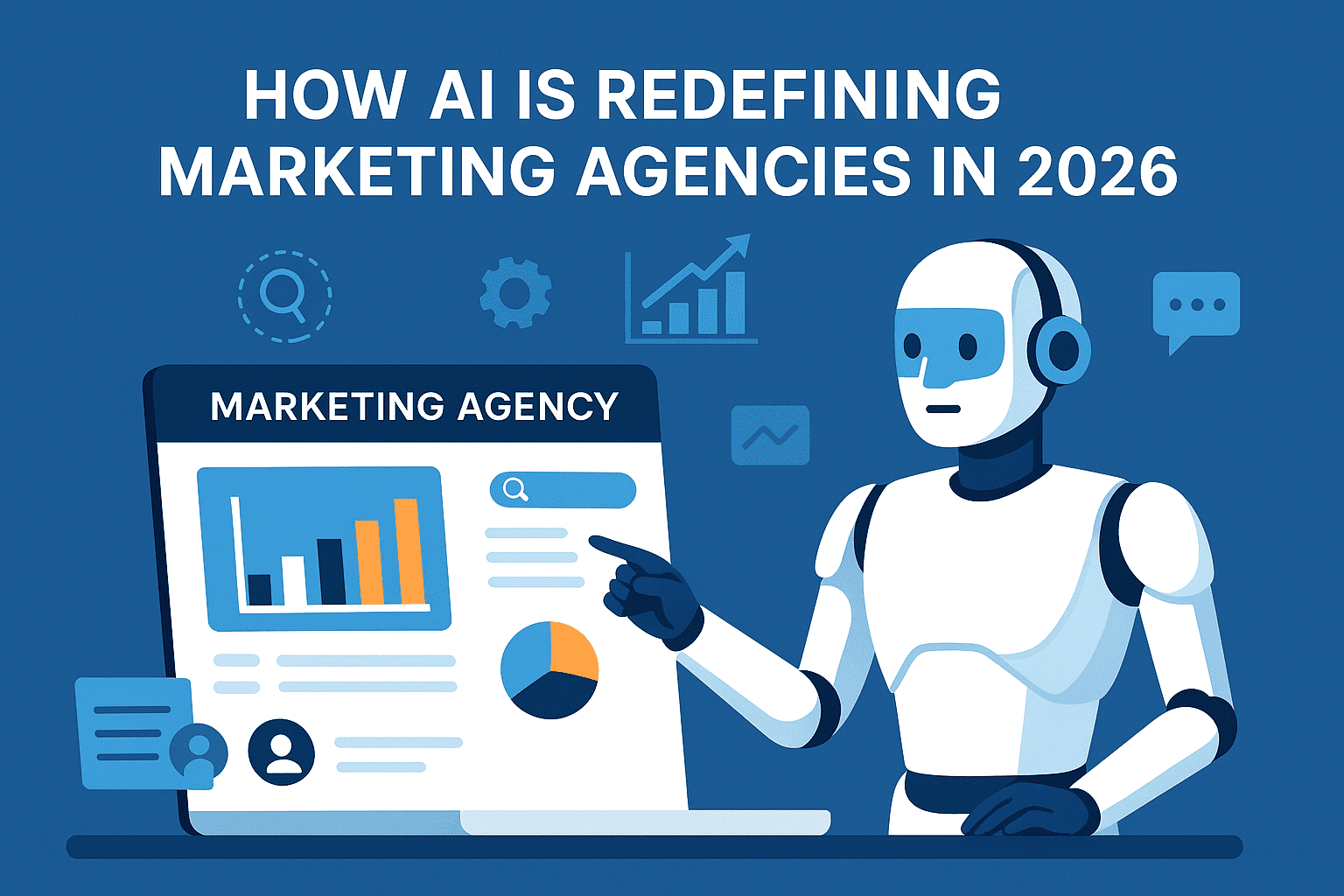
How AI Is Redefining Marketing Agencies in 2026
Artificial Intelligence (AI) is not just transforming how businesses operate—it’s completely redefining marketing agencies in 2026. From automating campaigns to predicting customer behavior and creating hyper-personalized experiences, AI has become the backbone of modern marketing strategies. Agencies that embrace AI are not just surviving—they’re thriving in a fast-paced, data-driven world.
Let’s explore how AI is reshaping marketing agencies and what trends are driving this transformation.
1. AI Is Becoming the Core of Every Marketing Strategy
In 2026, AI-driven marketing is no longer optional—it’s essential. Agencies are using AI to collect, analyze, and interpret massive amounts of customer data to make faster and smarter decisions.
Key impacts of AI on strategy:
-
Predicts customer intent and buying behavior
-
Helps identify high-performing marketing channels
-
Optimizes ad spend and improves ROI
-
Automates repetitive tasks like reporting, targeting, and audience segmentation
AI tools like ChatGPT, Jasper, and Google Gemini now help marketers plan, write, and even execute entire campaigns with precision.
2. Personalized Marketing at Scale
Gone are the days of generic marketing messages. AI enables agencies to deliver personalized experiences to every user—based on their behavior, location, and interests.
How personalization works with AI:
-
Real-time content recommendations
-
Automated email and chatbot responses
-
Geo-targeted ads for local audiences
-
Voice and visual search optimization
With this, GEO-targeted and AEO (Answer Engine Optimization) strategies are improving drastically—allowing agencies to reach the right audience at the right time, through the right channel.
3. AI-Powered Content Creation and Optimization
Creating engaging, SEO-friendly content has always been a challenge for marketers. But with AI-powered content tools, agencies can now generate high-quality blogs, captions, and video scripts in minutes.
Examples of AI in content marketing:
-
AI-driven SEO optimization tools (Surfer SEO, Frase, Clearscope)
-
Automated copywriting for ads and landing pages
-
AI video generators for reels, shorts, and social ads
-
Predictive content performance analysis
AI doesn’t replace creativity—it enhances it. Marketers can now focus more on strategy, storytelling, and innovation while AI handles the heavy lifting.
4. Smarter Advertising and Campaign Management
In 2026, ad campaigns are managed by AI algorithms that continuously learn and adapt. These systems analyze audience data, engagement metrics, and conversions in real time to maximize performance.
AI in advertising includes:
-
Smart bidding and automated budget allocation
-
Dynamic ad placement across channels
-
Predictive targeting for better conversion rates
-
Real-time A/B testing and creative optimization
With AIO (AI Optimization), marketing agencies are not just reacting—they’re predicting and shaping audience interactions.
5. Chatbots and Virtual Assistants Revolutionize Customer Experience
AI-powered chatbots and virtual assistants have become essential for every marketing agency. They offer instant communication, 24/7 support, and personalized experiences that enhance customer satisfaction.
Benefits of AI chatbots:
-
Instant customer response and lead qualification
-
Integration with CRM and email systems
-
Personalized conversation based on past interactions
-
Multi-language and voice-enabled support
This technology has made client communication more efficient while boosting conversion rates and customer retention.
6. Data-Driven Decision Making Through Predictive Analytics
Agencies are now relying heavily on predictive analytics—AI’s ability to forecast future trends and outcomes based on historical data.
Uses of predictive analytics in marketing:
-
Forecasting campaign performance
-
Understanding customer churn and lifetime value
-
Optimizing pricing and offers
-
Identifying market opportunities before competitors
By combining data, automation, and AI, agencies can make smarter, faster, and more accurate marketing decisions.
7. Creative AI: Blending Art with Technology
AI is also transforming the creative side of marketing. From design generation to voice cloning, AI tools can create stunning visuals, videos, and even personalized brand experiences.
Examples include:
-
AI-generated brand visuals and ad designs
-
Synthetic video creation for influencers or spokespeople
-
Music and sound generation for campaigns
-
Emotion-based design analysis
This fusion of creativity and technology is redefining what’s possible for agencies in 2026.
8. Ethical AI and Data Privacy in Marketing
As AI grows, so does the responsibility of marketers to use it ethically. Agencies must focus on transparency, data privacy, and fairness in every campaign.
Ethical AI practices:
-
Using first-party data responsibly
-
Gaining user consent for personalization
-
Avoiding algorithmic bias in targeting
-
Being transparent about AI-generated content
Agencies that follow ethical AI guidelines build stronger trust and long-term credibility with clients and audiences.
9. Future of Marketing Agencies: Human + AI Collaboration
AI won’t replace marketers—it will empower them. The most successful agencies in 2026 are those that blend human creativity with AI intelligence.
The future model:
-
Humans create strategy and storytelling
-
AI handles automation, analysis, and optimization
-
Together, they deliver faster, smarter, and more personalized marketing
This human-AI partnership defines the next era of marketing excellence.
Conclusion: Embracing the AI Revolution in 2026
AI has moved from being a support tool to a strategic partner for marketing agencies. It’s transforming how campaigns are planned, executed, and measured—making marketing more intelligent, efficient, and customer-focused.
Agencies that embrace AI today will not just adapt—they’ll lead the future of marketing in 2026 and beyond.
Share on